TL;DR
- This post targets VCF 9.0 GA only: VCF 9.0 (17 JUN 2025) build 24755599, with GA BOM examples including VCF Installer 9.0.1.0 build 24962180, ESX 9.0.0.0 build 24755229, vCenter 9.0.0.0 build 24755230, NSX 9.0.0.0 build 24733065, SDDC Manager 9.0.0.0 build 24703748, VCF Operations 9.0.0.0 build 24695812, VCF Automation 9.0.0.0 build 24701403, and VCF Identity Broker 9.0.0.0 build 24695128.
- Your topology choice is the first big day-0 decision:
- Single site usually starts with one fleet + one instance.
- Two sites in one region is typically one fleet + one instance with stretched clusters for higher availability.
- Multi-region typically becomes one fleet + multiple instances (often one instance per region for latency, sovereignty, and isolation).
- Your identity choice is the second big day-0 decision:
- Embedded VCF Identity Broker is the simplest and aligns to one broker per instance.
- Appliance VCF Identity Broker is a 3-node cluster, recommended for multi-instance SSO due to availability and scale (rule of thumb: up to 5 instances per broker).
- SSO model controls blast radius: fleet-wide SSO has the largest login blast radius; per-instance SSO has the smallest.
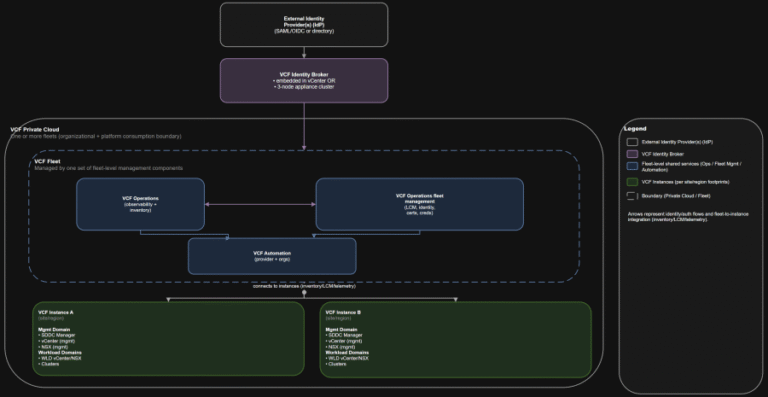
- Fleets are best treated as shared governance and lifecycle scope for management components, not a shared instance management plane. Instances keep their own SDDC Manager, vCenter, and NSX control planes.
Architecture Diagram
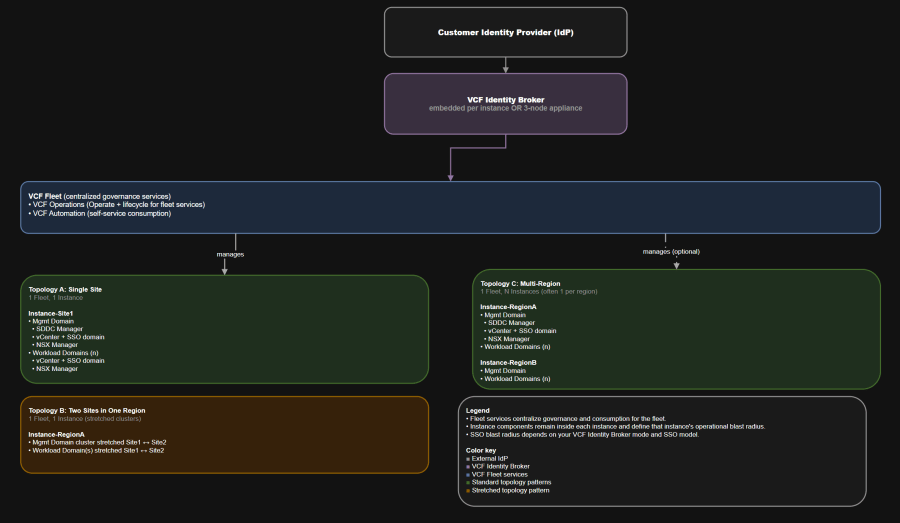
Table of Contents
- Scope and Code Levels
- Assumptions
- Scenario
- Core Concepts Refresher
- Decision Criteria
- Challenge: Pick Your Topology
- Challenge: Pick Your SSO and Identity Boundaries
- Architecture Tradeoff Matrix
- Failure Domain Analysis
- Who Owns What
- Operational Runbook Snapshot
- Change Management Considerations
- Anti-patterns
- Validation
- Summary and Takeaways
- Conclusion
Scope and Code Levels
Use these criteria to avoid arguing in circles.
Version Compatibility Matrix
VCF 9.x formalizes separation between:
| Component | Version | Build |
|---|---|---|
| VMware Cloud Foundation | 9.0 | 24755599 |
| VCF Installer | 9.0.1.0 | 24962180 |
| ESX | 9.0.0.0 | 24755229 |
| vCenter | 9.0.0.0 | 24755230 |
| NSX | 9.0.0.0 | 24733065 |
| SDDC Manager | 9.0.0.0 | 24703748 |
| VCF Operations | 9.0.0.0 | 24695812 |
| VCF Automation | 9.0.0.0 | 24701403 |
| VCF Identity Broker | 9.0.0.0 | 24695128 |
Assumptions
- You are greenfield and building your first VCF 9.0 platform.
- You deploy both VCF Operations and VCF Automation from day-1.
- You need patterns for:
- Single site
- Two sites in one region
- Multi-region
- You may need either:
- Shared identity (one IdP and unified SSO experience)
- Regulated isolation (separate IdPs and separate SSO boundaries)
Scenario
Failure domain notes
- Architects who draw the boxes
- Operators who keep the lights on
- Leaders who approve budgets and risk decisions
Day-1 posture
- “How many independent failure domains do we actually have?”
- “What is the blast radius when identity breaks?”
- “Do we have one private cloud or multiple?”
- “Who is on the hook when something fails at fleet vs instance scope?”
Core Concepts Refresher
Day-1 posture
- Fleet: where you centralize governance and fleet-scoped management services (not your per-instance management planes).
- Instance: a discrete VCF deployment footprint with its own management domain and workload domains.
- Domain: where lifecycle and isolation are designed to be independently managed (management domain + workload domains).
- Clusters: where you scale capacity and availability inside a domain.
Why you choose it
- If the question is “How do we run workloads here?” think instance -> domains -> clusters.
- If the question is “How do we standardize and govern across footprints?” think fleet.
Decision Criteria
In VCF 9.0, identity is not a minor checkbox. It drives operator experience, automation integration, and incident response.
Design-time decisions you should treat as “hard to change”
- Fleet count and why each fleet exists
- Instance per site/region strategy
- SSO scope and identity broker deployment mode
- Which components must survive a site failure vs a region failure
- Certificate and backup architecture for management components
Day-2 decisions you can iterate on
- Adding workload domains
- Adding clusters to domains
- Adding instances to an existing fleet
- Moving from per-instance SSO to cross-instance SSO (note: requires reset and reconfiguration, so treat as a major change event)
Challenge: Pick Your Topology
These are common failure modes that look fine in diagrams but hurt in production.
Solutions
Option A: Single site (one fleet, one instance)
Day-0 decisions
- One VCF fleet.
- One VCF instance in one physical site.
- One management domain plus one or more workload domains.
Day-0 decisions
- One VCF fleet.
- One VCF instance.
- Two sites in the same metro region, using stretched clusters to increase availability across sites.
Day-0 decisions
- One VCF fleet.
- Multiple VCF instances, typically aligned to regions (or sovereignty boundaries).
- Each instance has its own management domain and workload domains.
Day-0 decisions
- Each VCF instance uses its own dedicated VCF Identity Broker.
- SSO scope is limited to that instance.
- Users re-authenticate when moving across instances.
Day-0 decisions
- Multiple identity brokers exist.
- Each identity broker serves a set of instances in the same fleet.
- VCF management components (VCF Operations and VCF Automation) connect to only one identity broker for SSO, so choose that mapping deliberately.
Day-0 decisions
- One identity broker services all instances in a fleet.
- Users log in once and move across instances without re-authentication.
This article is written against VCF 9.0 GA terminology and design guidance.
- You value simplicity and a unified admin experience.
- You accept that identity is a shared dependency for the fleet.
What it is
- This has the largest login blast radius.
- You should strongly consider the appliance deployment mode for availability.
Embedded vs appliance identity broker
Use this chart to stop escalations from bouncing between teams.
- Embedded mode
- Runs as a service inside the management domain vCenter.
- vCenter maintenance impacts your ability to authenticate to VCF components.
- Simplest footprint.
- Appliance mode
- A standalone 3-node identity broker cluster deployed via VCF Operations fleet management.
- High availability comes from nodes running on separate hosts.
- Operational tasks on vCenter do not impact the authentication stack in the same way.
- Recommended for multi-instance SSO due to availability and scale (rule of thumb: up to five instances per broker).
Tenant multi-tenancy identity patterns in VCF Automation
Day-2 posture
- Enterprise model
- Provider and tenants use the same identity provider.
- Simplest for internal enterprise IT.
- Service provider model
- Provider and tenants use different identity providers.
- Better fit for regulated tenants, partner access, or MSP-style separation.
Architecture Tradeoff Matrix
What it is
| Decision point | Option | Strengths | Tradeoffs |
|---|---|---|---|
| Physical topology | Single site | Fastest to deploy, lowest complexity | No site-level resilience by default |
| Two sites in one region | Site resilience with one instance | Requires stretched network/storage design discipline | |
| Multi-region | Region isolation, scalable org model | Higher footprint, more coordination, DR becomes explicit | |
| Fleet count | One fleet | Centralized governance and consistency | Shared governance dependencies, shared change windows |
| Multiple fleets | Stronger governance isolation, separate identity boundaries possible | Duplicate fleet services, more ops overhead | |
| Platform SSO model | Fleet-wide | Lowest footprint, best UX | Largest login blast radius |
| Cross-instance | Balanced footprint and blast radius | More moving parts than fleet-wide | |
| Per-instance | Smallest login blast radius | Highest footprint and operational overhead | |
| Identity broker mode | Embedded | Lowest footprint | Coupled to vCenter maintenance, simpler availability story |
| Appliance | HA and scale, decoupled from vCenter maintenance | More resources and lifecycle tasks |
Failure Domain Analysis
Keep your runbook short and repeatable. This is a starting point.
Fleet service failure domains
- VCF Operations / VCF Automation unavailable
- Provisioning workflows, centralized operations views, and governance functions degrade.
- Your vCenters and NSX managers inside instances still exist, but you lose the consolidated interface and some automation paths.
- VCF Identity Broker outage
- Impacts logins based on your SSO model:
- Fleet-wide: impacts logins for the fleet.
- Cross-instance: impacts the subset of instances attached.
- Per-instance: impacts only one instance.
- Impacts logins based on your SSO model:
Instance failure domains
- Management domain outage (inside an instance)
- Impacts that instance’s lifecycle and management capabilities.
- May also impact authentication if using embedded identity broker in that instance.
- Workload domain outage
- Impacts workloads isolated to that domain.
- Does not necessarily take down the instance management domain.
Who Owns What
You are trying to align:
| Capability / task | Platform team | VI admin | App/platform teams |
|---|---|---|---|
| Choose fleet count and topology blueprint | ✅ | ⬜ | ⬜ |
| Define instance-per-site/region strategy | ✅ | ✅ | ⬜ |
| Deploy first instance and management domain | ✅ | ✅ | ⬜ |
| Deploy fleet services (VCF Operations + VCF Automation) | ✅ | ⬜ | ⬜ |
| Create workload domains | ✅ | ✅ | ⬜ |
| Define SSO model and identity broker mode | ✅ | ✅ | ⬜ |
| Configure VCF Single Sign-On and component registration | ✅ | ✅ | ⬜ |
| Provider identity in VCF Automation | ✅ | ⬜ | ⬜ |
| Tenant identity in VCF Automation (enterprise vs service provider model) | ✅ | ⬜ | ✅ |
| Day-n operations in a region (multi-region) | ⬜ | ✅ | ✅ (workload level) |
| Certificate lifecycle standard and tooling | ✅ | ✅ | ⬜ |
| Backup and restore strategy for management components | ✅ | ✅ | ⬜ |
| Workload onboarding, catalogs, templates, guardrails | ✅ | ⬜ | ✅ |
Operational Runbook Snapshot
Even if you are on 9.0 GA today, your day-2 operating model should assume this separation so upgrades do not surprise you later.
Daily
- Check platform health in VCF Operations (fleet services and connected instances).
- Validate identity broker health and login paths.
- Verify capacity alarms and failed automation runs.
Weekly
- Confirm backups for:
- VCF Operations and fleet management services
- VCF Automation
- Identity broker (appliance mode) or vCenter backups (embedded mode)
- Instance core components (SDDC Manager, vCenter, NSX)
Monthly
- Review certificate expirations and renewal pipeline.
- Review drift and out-of-band changes.
- Review tenancy boundaries and entitlement creep.
Incident workflow
- Identify scope first:
- Fleet services issue vs instance issue vs workload domain issue
- For identity incidents:
- Identify which identity broker and which SSO model is in use for impacted components.
- Decide if this is a login outage only, or also an authorization/role mapping problem.
Change Management Considerations
Operational reality
Identity resets are a major change event
Failure domain notes
- Identity broker deployment mode (embedded <-> appliance)
- Identity provider changes
VMware Cloud Foundation 9.0 and later documentation (includes VCF 9.0 Release Notes, Bill of Materials, Design Blueprints, and VCF Single Sign-On models): https://techdocs.broadcom.com/us/en/vmware-cis/vcf/vcf-9-0-and-later/9-0.html
- A planned outage window
- A rollback-resistant change (because users/groups and component registrations are impacted)
- A runbook that includes role and permission re-assignment
Lifecycle sequencing matters
These are the changes that most often turn into “why is this so hard?”
- Management components managed at fleet level
- Core components managed at instance level
Treat these as distinct failure domains with different operational responses.
Anti-patterns
Use this matrix in design reviews to avoid subjective debates.
- Designing multi-region without explicitly deciding where fleet-level services live and how you recover them.
- Choosing fleet-wide SSO for operator convenience without acknowledging the login blast radius.
- Using embedded identity broker in environments where vCenter maintenance windows are frequent and strict uptime is required.
- Treating “separate IdP” as enough isolation while keeping everything in one governance boundary.
- Letting tenants share identity or entitlements by accident in VCF Automation due to weak onboarding guardrails.
- Skipping workload domains and placing consumer workloads in the management domain.
Validation
Validate code levels quickly (vCenter example)
Day-0 decisions
What it is
- Fleet Management -> Identity & Access -> SSO Overview
- Verify:
- Selected VCF instance
- Identity provider configuration
- Component configuration state for vCenter, NSX, VCF Operations, VCF Automation
Summary and Takeaways
- Use topology blueprints to align teams quickly:
- Single site for speed
- Two sites in one region for site resilience
- Multi-region for sovereignty, latency, and isolation
- Treat instances as your discrete infrastructure footprints.
- Treat domains as lifecycle and workload isolation units.
- Treat fleets as your centralized governance and fleet-scoped lifecycle boundary.
- Choose your SSO model based on blast radius tolerance, not just convenience.
- Decide early if tenants need separate identity providers, and use VCF Automation provider/tenant identity models intentionally.
Conclusion
You get operational clarity in VCF 9.0 when you design topology and identity as first-class boundaries:
- Topology sets your failure domains and scaling ceiling.
- Identity sets your operator experience and incident blast radius.
- Fleets centralize governance, while instances keep their own management stacks.
Sources
Day-2 posture